Visualizzazione post con etichetta Victorian Style. Mostra tutti i post

giovedì 6 febbraio 2014

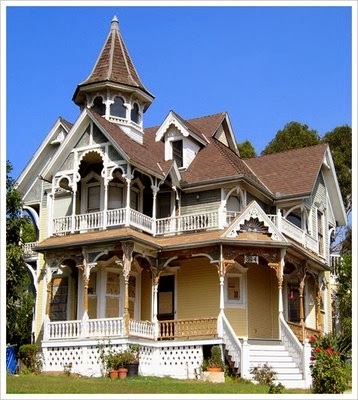
Gingerbread Cottage in Historic Mount Tabor

Gingerbread Cottage in Historic Mount Tabor
This one-bedroom gingerbread cottage is so colorful and quirky that it made me smile. You don’t see houses like this very often!

It was built in 1871 and is on the market in the Historic Mount Tabor neighborhood of New Jerse.

Decorative ironwork, ornate woodwork and whimsical details throughout. Double door entry to LR w/amazing plaster ornaments, stained glass in baywindow nook and beamed ceiling w/antique pendant lights.

Wood brng stove. HW flrs throughout FF. Gingerbread arch into DR & Kit. Updated Kitchen w/Corian ctrs, cherry cabs, door to yard, Powder Room. DR slate fireplace backing, picture window.

Oak stairs w/antique carved oak niche for display. Wide plank heart pine flrs on 2nd level. MBR w/Sitting Area/poss 2nd BR. Ornate gingerbread arch w/glass details btwn. rooms. MBR features loads of light from cupola skylight and double doors to the beautiful balcony.

Remod. Bath w/antique ovrszd ped. sink & claw foot tub. Serene Yard w/iron gazebo, perennial plantings.

Photos of Gingerbread Cottage in Historic Mount Tabor:

Gingerbread Cottage in Historic Mount Tabor
Gingerbread Cottage
Interior of Gingerbread Cottage

mercoledì 5 febbraio 2014

Castle Victorian, New Old house

Castle Victorian, New-Old house
Castle Victorian is a "New-Old house" constructed from architectural plans first drafted in 1885.   This tribute to Victorian architecture was started in 1999 and completed in 2002.  This website is dedicated to the process of building a "New-Old House", not a "Fake-New Victorian", but a home worthy of the title, Victorian.

The 1885 version was built in Kansas City, MO and was documented in a book of old house plans.  The illustration in the lower right corner is from that book.   The original house, pictured to the right, still stands in the Pendleton Heights neighborhood of Kansas City, MO.

In 1999, my wife and I accepted the challenge to reconstruct this house in a manner that embraced the intricate details of this grand, High-Victorian home.

Building an authentic "New-Old house" that embraces the character and quality of a historic home is possible, but it takes a lot of dedication, effort, time and financial investment.  We hope you find inspiration here as you consider your personal Dream House project.  Just select a tab, above, (start with "The Dream" and work your way across).


Website: http://www.castlevictorian.com/

martedì 4 febbraio 2014

Craigdarroch Castle

Craigdarroch Castle
Craigdarroch Castle in Victoria is an imposing Victorian mansion completed in 1890 for Robert and Joan Dunsmuir, Scottish immigrants who made their fortune from Vancouver Island coal.

Robert Dunsmuir died in 1889, just months before his majestic Craigdarroch Castle was completed. Although he arrived on Vancouver Island a poor coal miner, he built an empire and became the wealthiest and most influential man in British Columbia.

The fortune Dunsmuir amassed is reflected in every piece of the finest wood, stone and glass meticulously tooled to create Craigdarroch Castle, now a national historic museum featuring an extensive collection of stained and lead glass windows, magnificent woodwork, Victorian furnishings and decorative arts.

To tour the Castle, you can park on the Castle lot or on the street where indicated. You enter through the old coach entrance, pay your admission fee, clean your shoes and are then provided with a floor map, family history and introduction as to how to proceed. Tours are self-guided, so you can stop where you want. It should take you 45 minutes to an hour to tour through the Castle.

 Victoria's legendary landmark. Experience the lifestyles of the rich & powerful at the end of the 19th century. Completed in 1890, the Castle is now a historic house museum.

Lavish Victorian era furnishings & decor, exquisite stained glass & detailed woodwork carved by artisans of days gone by... These all combine to create a warm & expansive entertainment experience.

When you're finished, take time to browse the Gift Shop & relax in the newly restored (2010) grounds before moving on to your next destination.

Open daily for self-guided tours.

1050 Joan Cres, Victoria
British Columbia, V8S 3L5
Phone250-592-5323
Fax250-592-1099

Victoria Packages

 Victoria Packages

Experience Victoria, BC

Victoria, BC vacation packages are a great way to experience Victoria, enjoy your getaway, and save.

Clipper Vacations’ most popular Victoria package is the Seattle to Victoria Overnight Package which may be customized with extra nights, activities and tours to create your ultimate Northwest vacation.

Other favorite package options include romantic getaways, family-friendly adventures, unforgettable day trips and more.

Whether you’re strolling along the causeway in the Inner Harbour, enjoying a whale watching adventure, indulging in the distinct West Coast cuisine, or taking in a local theatre production, Victoria’s many attractions paired with a Victoria hotel and transportation on the Clipper add up to a trip that is nothing short of breathtaking...read more.

lunedì 3 febbraio 2014

Coconut Macaroons

Coconut Macaroons
Almond macaroons have been popular sweetmeats in England since medieval times.
Coconut macaroons are a Victorian version of the original recipe using dried coconut in place of ground almonds. Made this way, children love them! Top with a sliver of candied cherry or tint them the palest pink with a drop or two of red food coloring.

Ingredients
Rice paper
1 cup confectioners’ sugar
3 cups dried coconut
2 egg whites
Glace cherries, sliced

Preparation
Lay the rice paper on an ungreased baking sheet with the smooth side uppermost. Preheat the oven to 325 degrees F.
Whisk the egg whites until stiff. Whisk in the sugar, then fold in the coconut. Pile the mixture in twelve pyramid shapes on the rice paper. Top each pyramid with a small slice of cherry.
Bake for 20 to 30 minutes, or until a pale golden brown.
Leave on the baking sheet until cold. Tear around the rice paper to separate. Makes 12.

Cucumber Tea Sandwiches

Cucumber Tea Sandwiches
Ingredients:

16 slices of cracked wheat bread
2 teaspoons lemon juice
1 8-ounce package cream cheese
1 medium cucumber, sliced thin
2 tablespoons chopped fresh chives
2 tablespoons chopped fresh parsley
carrot curls


Preparation:

Remove crust from bread and cut into rounds. In a small bowl, combine cream cheese, chives, parsley, and lemon juice. Blend well. Spread each cutout with cream cheese mixture. Top with a cucumber slice and garnish with a carrot curl. Store in refrigerator. Makes about 32 sandwiches.

Victorian House Museum

Victorian House Museum
Victorian House Museum - Holmes County Historical Society

In the heart of Ohio Amish country, this beautiful Victorian Mansion is the home of the Holmes County Historical Society. 
With 28 beautifully appointed rooms waiting for your discovery, this classic example of Queen Anne architecture is full of antiques furnished by local citizens. 

From the breath taking facade to the elegant white oak staircase that greets you as you enter, you'll be amazed at the details you find in this gem of Millersburg. You will step back in time as you tour all four floors of our mansion, from the exquisite ballroom on the fourth floor to the sauna and steam room in our basement. 

Our tours are self-guided, so take as much time as you want. Beautiful parquet floors are a must see! There is something here for everyone, young and old. Tours are self guided March weekends only, April - Oct. Tues. - Sunday- $8.00 for adults,senior citizen $7.00, students $3.00 and children under 12 FREE! Bus tours are welcome and can be arranged for special times. Why not spend the day in historic Millersburg to complete your tour?
Address
Victorian House Museum 484 Wooster Rd.
Millersburg, Ohio 44654
Phone Number(s)
Toll-Free: (888) 201-0022
Local Number: (330) 674-0022

E-mail Address(es)
info@holmeshistory.com

Hours
Sunday: 1:00 PM - 4:00 PM
Tuesday: 1:00 PM - 4:00 PM
Wednesday: 1:00 PM - 4:00 PM
Thursday: 1:00 PM - 4:00 PM
Friday: 1:00 PM - 4:00 PM
Saturday: 1:00 PM - 4:00 PM

sabato 1 febbraio 2014

Victorian Easter Cards

Find the largest selection of victorian easter card.

Everyone loves to receive a special message in the mail from loved ones, and our collection of old-fashioned cards, postcards and stickers will help you express your warmest Easter greetings with a distinctive, traditional flair.

Easter Greeting Card


Easter Victorian Card


Easter Victorian Card

Easter traditions during the Victorian era

Easter Card
Many of our current Christmas and Easter traditions originated back in the Victorian era which covered the duration of Queen Victoria's reign over the UK from 1837 to 1901.
At that time England was emerging from its historic Puritanical bans on celebrations. The people at that time were filled with joy and hope as they embraced a new world of merry celebrations and traditions. Today many of these Victorian traditions are still popular and there is no sign that they will be abandoned.

The Easter Holiday

Easter is one of the major Christian festivals of the year in the UK. The participants enjoy its customs, folklore and traditional foods. It is an ancient holiday dating back to pagan times long before Christianity arrived in Britain. The first English historian, the Venerable Bede, wrote that Easter derived from the Anglo-Saxon goddess of the dawn and spring--Eostre.

Easter falls at the end of the winter and the end of Lent, which is a time of fasting during the Christian calendar. This is a joyful holiday marked by feasting, fun and celebration. The British national holidays for Easter come on the Friday before Easter Sunday and the Monday afterward. The schools are closed for two weeks and the children devour chocolate in large quantities.

Victorian Traditions

A large variety of Victorian traditions have survived the years. One favorite is Easter cards, which began in the late 18th century when a publisher added an Easter greeting to a drawing of a bunny on writing stationery. Sending the cards is a fun practice which is now growing in the US as well.

The Easter Lily became popular in symbolizing life after death, since the bulb grows, blooms, dies back and grows once again during the following year. Although tulips, daffodils and narcissus follow the same life cycle, the lily with its large size and white blossom is an excellent symbol of resurrection during the season.

Easter parades allow the participants in the processional to show off their spring finery after Easter Mass as they stroll through the streets following a priest or minister with a crucifix or a candle. The Easter bonnet became a favorite adornment for women and girls to show off as they walked. During Victorian times, a beau might give a pair of gloves to his sweetheart and if she wore them during the parade, she was announcing her acceptance of his marriage proposal.

The children were especially excited when they awoke on Easter morning to see what the Easter bunny had brought them for their Easter baskets. If they had been good throughout the year, they could expect a variety of chocolate eggs and bunnies, jelly beans and other sweet treats. Egg rolling contests and Easter egg hunts were/are a favorite pastime during this holiday.

In some areas, Morris dancers perform a folk dance which has roots dating back to the Middle Ages. The men dress in colorful costumes with hats and ribbons. They also wear bells around their ankles as they dance through the streets. Some carry sticks with inflated pigs' bladders tied on the end. When they dance up to young women, they smack them over the head with the bladder. This is supposed to bring them luck. One wonders just what kind of luck the lady might find afterward--or is it the young man who gets lucky?

Maundy Thursday

This is the Thursday before Easter, commonly remembered as the Last Supper, when Christ washed his disciples' feet as an act of humility. The word "Maundy" comes from the French word, "Mande," which means "command." The Ceremony of the Royal Maundy in Britain dates back to Edward I.

It is traditional for the British Queen to participate in the ceremony. She distributes Maundy Money in white and red purses to senior citizens which amounts to one man and woman for each year of her own age. This tradition dates back to at least the 17th century when the royal sovereign washed the feet of some poor people as a gesture of humility. The last royal monarch to participate in this version of the tradition was James II.

The British continue to enjoy their Victorian Easter traditions which they still practice today. As a side note, today the Easter Bunny is just as popular as Santa Claus.

Source

An Easter Celebration: Traditions and Customs From Around The World by Pamela Kennedy; Ideals Publications; 1991

venerdì 31 gennaio 2014

A Victorian cottage in the woods

Sandra Foster's magical one room cottage in The Catskills New York.

Sandra turned the former hunting cabin into a romantic cottage she had always dreamed of using salvaged architectural finds and doing the carpentry herself!

Victorian Cottage of Sandra Foster


Victorian Cottage in the Wood

Interior of Sanda Foster's Cottage

Buying a Victorian House

Victorian House
There are still many examples of Victorian houses in the United States, some of which are in great repair, while others are fixer-uppers. They were built in the nineteenth century, from about 1830. If you're interested in history and these lovely homes, you may be interested in buying your very own Victorian house.

1 Learn what makes a house a true Victorian house. Victorian houses usually have steeply pitched roofs, textured shingles, a partial front porch that usually extends along one or both sides walls and an asymmetrical design.

2 Contact a real estate agent that specializes in selling older homes, including Victorian homes. You may find there are quite a few Victorian Houses in your area.

3 Go to different websites to see listings of Victorian houses currently for sale throughout the country.

4 Be prepared to spend more money on this house than just the buying costs. Victorian houses usually require a great deal of upkeep, even if it's in good repair. Consider getting a Victorian house in poor repair and doing the repair work to get a deal on the price of the house.

5 Contact The Victorian Society in America for more information about the preservation of your house. You will want to be careful when doing repair and general upkeep that you're not permanently destroying history. Consider doing some research to make your Victorian house as authentic as possible (while still conforming to our comfort and sanitation levels).

Is Your House Victorian?

Victorian House

Is Your House Victorian?

Spanning the reign of Queen Victoria, the Victorian era (1837 to 1901) was a time of monumental change in many ways.

The Industrial Revolution meant that innovative techniques were being introduced, worldwide trade was opening up and the rapid economic growth then led to a big increase in building. And, with the creation of the railways and many new manufacturing processes, locally produced building materials - which were previously only used in the immediate area - soon became available all over the country.

Why Do Victorian Houses Look Like They Do?

People took a lot of pride in their properties and the more affluent classes saw their home as a big reflection of their status.

There was certainly an eclectic mix of styles throughout the Victorian era, with lots of adornment and trimmings, but it can also be said the Victorian age was very much a period of imitation and reproduction - many styles, which were previously popular, were revived.

giovedì 30 gennaio 2014

Women’s Victorian Shoes and Boots

Victorian Shoes
“Tavistock” Authentic Victorian Button Boots- Ivory or Black Victorian women were notable for their high black lace up boots.

 Often called granny boots, vintage western boots or witch’s boots they are popular with civil war and Victorian event re-enactors.

Steampunk costumers love to add gears, buckles, brass, and lot of attitude to traditional Victorian shoes.

Whether you need Victorian womens shoes, Victorian wedding boots, Steampunk boots, or hardy all purpose lace up boots you can find them here

John Anster Fitzgerald

John Anster Fitzgerald is chiefly known as one of the outstanding exponents of victorian fairy painting, and is also known as ‘Fairy "Fitzgerald.’

Having had no known formal artistic training, Fitzgerald was regularly exhibiting at the Royal Academy by 1845, at the age of 23. Dating from the early 1860s, The Chase of the White Mouse (estimate: £180,000-250,000) is one of the artist’s most important and highly esteemed works.

The star lot of the sale, this painting encapsulates all the key elements of Fitzgerald’s fairy subjects, boasting iridescent colours and superb detail.

The playfulness and whimsy have been noted as being savagely undercut by touches of cruelty, characteristic of the darker undercurrent of so many fairytale stories."

The Chase of the White Mouse

Garden: Flowers, Decorations and Seating

Victorian Garden
How to Plant a Victorian Garden: Flowers, Decorations and Seating

Victorian gardens are very popular because of their romantic beauty and abundance of style. Although the Victorian age is long gone the Victorian style is still loved by many, and a Victorian garden is an excellent way to display your love of this time period. This article will describe how to plant your own Victorian garden.

There are many popular plants from the Victorian period; flowers, tree, shrubs, and vines can all be incorporated into your garden. Trees were usually put in spots that would block the hot summer sun from the house. Shrubs were used to accent paths and cover up unsightly foundations. Vines were also use to cover up parts of a garden or home that weren't so attractive, and they were used for shade. Symmetrical flower beds were popular in a Victorian garden, and consistent height was predominantly found in flower beds. A wide variety of foliage and fauna is appropriate in a Victorian garden, but there are traditional flowers and shrubs that will achieve a Victorian theme in your garden.

There is a very long list of flowers and shrubs are reminiscent of the Victorian garden style. Lilies, magnolia, larkspur, zinnia, daffodil, and begonias are all common Victorian flowers. Aster, tulips, blue sage, and lavender were also very popular in these gardens. Clematis, wisteria, and morning glories are Victorian vines. When creating a Victorian garden it is important to include traditional shrubs such as rose, hydrangea, and lilac. Many Victorian shrubs are easy to find and inexpensive.
Choosing decorations for your Victorian garden can be easy and fun. Wooden scrollwork is appropriate for this type of garden, and you can find interesting wooden items to add to your Victorian garden. Wrought and cast iron is another element of this type of garden; it can be incorporated into fences, benches, and other parts of your garden. Gazing balls, urns, statues, and other forms of sculpture will add an even more personal touch to your Victorian garden.
Victorian gardens are a place where beauty is meant to be observed, and there were usually benches and seats in these types of gardens. Seating for a Victorian garden can be made from wood or iron, and it should have a natural looking. Seats where commonly placed in shaded areas, and vines would be used to shade sunrooms and porches. Being able to sit and relax in was an important theme for a Victorian garden.

Creating a Victorian garden is easy if you know what the basic characteristic elements of a Victorian garden. Keeping the many shrubs, vines, flowers, and trees is important in a Victorian garden, and decorations and seating is another aspect of Victorian gardening that should be incorporated appropriately.

How do I Decorate a House in a Victorian Style?

Victorian Style Interior Decor
Victorian decor reflects the tastes and styles of this era. According to Creative Home Decorating Room by Room, the Victorian period "was an era of ornate and excessive decoration in all things," which was preceded and followed by simpler times.

In addition to the ornate, lighter Victorian decor often favored by bed and breakfasts, the Victorian era also had a more masculine side, and often used dark furniture and animal trophy accessories throughout the home.

If you own a Victorian home and are selling your property, adding a bit of Victorian flair may enhance and accentuate the historic value of your home. San Francisco in particular is home to several thriving Victorian home districts, such as Pacific Heights and the Western Addition.

1

Purchase antiques from the Victorian era. Search local antique shops, particularly any stores that may specialize in Victorian antiques. Antique shops can be pricey, so also look at thrift stores, which may offer additional antiques for lower prices.

2

Replace plain light fixtures with ornate Victorian pieces. Look for chandeliers, beaded lampshades, and cast iron lanterns. For a truly authentic feel, use Victorian candle holders and candleabras to provide dim lighting in your formal dining or living room.

3

Replace drapes and blinds with Victorian window treatments. The Victorian era tended to use lush, ornate fabrics such as velvet and silk, with rich color tones. As noted at From Times Past, one telltale sign of a Victorian era home is stained glass windows, which can be purchased at home improvement stores or found in antique shops. (See Reference 4)

4

Accessorize with decorative vases and bold floral arrangements, animal trophies, needlepoint pillowcases, Grecian busts and vases, and a wide variety of knick-knacks and miniatures. As noted at The New Homemaker, you may also want to invest in display cases and box-style frames to prevent breaking and minimize dusting.

5

Hang Victorian wall art, such as antique mirrors, needlework, portraits and nature pieces. Use ornate frames to accentuate artwork and portraits.

Victorian Tea Time

Victorian Tea Time
19th Century

According to legend, one of Queen Victoria's (1819-1901) ladies-in-waiting, Anna Maria Stanhope (1783-1857), known as the Duchess of Bedford, is credited as the creator of afternoon teatime. Because the noon meal had become skimpier, the Duchess suffered from "a sinking feeling" at about four o'clock in the afternoon.

At first the Duchess had her servants sneak her a pot of tea and a few breadstuffs. Adopting the European tea service format, she invited friends to join her for an additional afternoon meal at five o'clock in her rooms at Belvoir Castle.

The menu centered around small cakes, bread and butter sandwiches, assorted sweets, and, of course, tea.

This summer practice proved so popular, the Duchess continued it when she returned to London, sending cards to her friends asking them to join her for "tea and a walking the fields." The practice of inviting friends to come for tea in the afternoon was quickly picked up by other social hostesses.

Photos of Victorian Houses

Victorian houses are architecturally commonly referred to as the Victorian Style but this "style" is really a period in history. The Victorian era roughly corresponds to the time when Queen Victoria ruled Britain (1837 to 1901).
During this time, industrialization brought many innovations in architecture. There is a wide variety of Victorian styles, each with its own distinctive features.

Types of Victorian Styles Include: Second Empire, Queen Anne, Stick, Shingle, and Richardsonian Romanesque.

Photos of Victorian Houses:

Pine Meadow, Connecticut


Cape May - New Jersey


West Cliff Inn, Santa Cruz


Washington, Georgia


Seven Sisters Inn, Ocala Florida

Victorian Jewelry

Victorian Jewelry
The Victorian era spanned 64 years and is divided into 3 major periods, The Early Victorian Period, or Romantic Period, spanning 1837-1860; the Mid or High Victorian Period, also known as the Grand Period spanning 1860-1885; and the Late Victorian Period, or Aesthetic Period spanning 1885-1901.

Jewelry of the Early Victorian Period 1837-1860

The early years of the Victorian era were described as romantic or sentimental and reflected the youth, courtship and marriage of the young queen, Victoria. Britain was in a state of industrial euphoria, obsessed by mechanical gadgets.

The world of nature, inspired from styles of the Renaissance and Middle Ages, was still a very popular motif in Victorian Jewelry. Bouquets of flowers, branches, leaves, grapes and berries remained fashionable. There was a symbolism associated with flowers that carried through the first half of the century. Snake and serpent motifs reached their peak in the 1840's. The snake used as a decorative motif symbolizes wisdom and eternity. Victorian jewels were often set with gems that were attributed with magical properties and special meanings. Seed-pearls denoted tears, and pink coral could protect one from evil and disease. Love tokens and souvenirs from travel or events were cherished.

The most popular metals incorporated into the jewels of the era were 18k to 22k gold, tricolor gold, silver, rolled gold and electroplate. Before the process of electroplating was discovered, less expensive jewelry pieces were produced using pinchbeck. Electroplating produced far better results, as it covered the entire surface of an object with a film of gold making it superficially indistinguishable from the real thing. Advancements were also made in the development of imitation stones. Parian, an ivory imitation made from a type of porcelain, was carved and used for Victorian brooches and clasps.

Most of the jewelry in the Early Victorian Period was hand manufactured, but the industrial revolution was introducing methods of manufacture that could greatly speed production. In 1852 a method for cutting and stamping settings was developed. This allowed entire pieces of jewelry to be made quickly and very inexpensively.

In the late 1830's to early 40's, lady's clothing fashionably covered all of the body. High necklines and bonnets covered the ears, therefore, necklaces and earrings were not often worn. Extremely large brooches were in vogue, and worn at the neck during the day, or at the low décolletage, often combined with fresh flowers, for evening wear. Adornment of the hands and wrists became increasingly important, with Victorian rings and large bracelets designed to make the hand look dainty and feminine.

Gold and silver Scottish Victorian brooches, often depicting the foot of a grouse or a thistle, began to appear throughout Britain after Victoria and Albert bought Balmoral in Scotland in 1848. Multi-colored agates were common accents. Many were set with Cairngorm's, a variety of golden smoky quartz found only in the Cairngorm Mountains. Cairngorms are no longer mined and today either citrine or smoky quartz is used as a substitute.

The British government did not require jewelers to use any hallmarking system during the 19th Century, so a characteristic of jewelry made during this time was a lack of a maker's mark or quality stampings. Before 1854, most of the jewelry produced was 18k. After 1854, 9k, 12k and 15k were made legal in order to compete with international markets. This information is a great aid in circa dating.

In the 1850's lady's clothing took an elegant turn. Hair was worn, parted in the middle, in an elegant upsweep, which lent itself to diadems becoming popular and we see the reappearance of earrings. Bracelets remained in fashion, worn alone or in pairs. The tours of Egyptian tombs, offered by Thomas Cook, led to a popular Egyptian Jewelry Revival. Fortunato Castellani, was inspired by the ancient world and produced a collection of "archaeological" jewelry that fetched enormous prices throughout Europe.

The most widespread gemstones used in jewelry during the Early Victorian Period were diamonds (rose-cuts and brilliants), amethyst, pink and golden topaz, turquoise, chalcedony, coral, garnet, ruby, seed pearls and cameos. Cameos were fashioned out of many elements, including shell, lava, coral and micro-crystalline, layered quartz varieties.

Mid Victorian

What started as a decade with optimistic expectations, ended abruptly for England. In 1861, Victoria's mother, The Duchess of Kent passed away, followed later in the year by the passing of her beloved husband Prince Albert. Victoria and the nation were stunned and devastated by grief.

At the same time, in the United States, the first shots were fired marking the beginning of the Civil War. What was expected to be a short conflict, raged into years of battle.

On both sides of the Atlantic, lockets became a very important fashion accessory. They held the memory of a dear one close to the heart. They could contain locks of hair or early examples of photographs (daguerreotypes), kept in secret compartments. Victorian lockets were often suspended from "book chain" necklaces and adorned with taille d'epargné style enamel work. Book chain necklaces had a dual purpose;when these flat chains were removed at night, they could be used as a bookmark!

Victorian mourning jewelry and clothing followed a strict protocol. After a year of full mourning (requiring all black jewelry and clothing), half-mourning colors such as gray, mauve, or purple were allowed back into the wardrobe. Jet, Onyx, Gutta-Percha, Vulcanite, French Jet, and Bog Oak were common materials utilized for mourning jewelry.

In 1865, America was hit with another dismal blow. President Lincoln was assassinated, a mere month into his second term;death was an overwhelming reality of life during Victorian times.

Travel and exploration of ancient sites became easier as the century progressed. There was a continued fascination with Egyptian and Etruscan Revival pieces, but in the 1870's the United States made some discoveries that influenced the trends. The Treasure Vaults of Kurium resulted in the popularity of Phoenician inspired crescents; Victorian crescent jewelry was enameled, jewel encrusted, and adorned with granulation. The crescent motif, fashioned into brooches, earrings and pendants remained popular until after the turn of the century.

It was during the Victorian era that opals first gained their reputation for bringing bad luck to the wearer, other than being worn as a birthstone. It's thought that Sir Walter Scott originated this concept in a best selling book, titled Anne of Geierstein , about an opal hair ornament that brought catastrophe to its owner. After a huge discovery of opal was made in Australia (a British Territory) in 1870, Queen Victoria herself tried to dispel the superstitions surrounding opals. By 1886, opals had lost much of their unlucky reputation and were being used in the newest Victorian designs.

In the late 1880's it became a trend to take the ornately hand pierced cock covers from watches made in the 1600-1700's and fashion them into earrings, bracelets and pendants. This was appropriately called "Cock Cover Jewelry". The cock covers protected a watch's balance's wheel and staff. They were usually made out of a gilded brass.

Popular gemstones in the mid-Victorian period were amethysts, cabochon garnets, crystal, emeralds, diamonds, onyx, opal, pearl, ruby, black glass, bog oak, jet, ivory and tortoise shell.

Silver jewelry, both plain and oxidized, became very popular in the late 1800's. The discovery of silver in Virginia City, Nevada in the 1860's greatly reduced the price of silver and provided a source for the metal needed to create many of these designs, which reflected a growing middle market. Both low and high karats of gold were also used extensively. Engraved bangle bracelets, monogram and name brooches and sentimental lockets developed a more whimsical character in the late 1880's. Acorns, anchors, monograms, hearts, bees, bells, birds, swans, stars, sphinxes and daisies were all in vogue.

Late Victorian

The early years of the Victorian era were described as romantic or sentimental and reflected the youth, courtship and marriage of the young queen, Victoria. Britain was in a state of industrial euphoria, obsessed by mechanical gadgets.

The 1890's were exciting, prosperous and ground-breaking times in our history. Women were increasingly involved in the business world and the stock market. Workers generally enjoyed much more leisure time, making entertainment a thriving business. Darwin's controversial theories on evolution were widely publicized. The automobile was revolutionizing transportation!

Throughout the 19th Century exhibitions played a major role in introducing the public to innovations in art and industry. To celebrate the 400th Anniversary of the discovery of the United States, Chicago hosted the 1893 Colombian Exposition. The highlight of the show was electricity! Visitors to the show were awestruck by fabulous, illuminated displays by some of America's top designers like Tiffany and Gorham. Case after case of Victorian chains, rings, bracelets, earrings, and watches were met with great enthusiasm. The jewelry was lighter and on a smaller scale than in previous years. Clothing was getting lighter as well. Heavy Victorian brooches were replaced by smaller pins scattered on the bodice of a dress. Diamond pins were often worn in the hair for evening. Small stud earrings were desirable as latest Victorian hairstyles were exposing the ears.

The manufacturing of Victorian jewelry had shifted from hand-crafting to mass production by machine. This suited the growing demand of consumerism by an emerging middle class. Machine-made curb-link bracelets, often with dangling hearts and keys were first introduced at this time. The revival motifs were still wildly popular. Crescents and Etruscan and Egyptian inspired jewels were being extensively produced. The Darwinian controversy and numerous botanical discoveries led to Victorian jewelry designs that reflected the natural world. Insects, like gem-set butterflies, enameled beetles and gold houseflies were in great demand. Hunting and sporting motifs were also well-liked.

Activities for women such as bicycling and golf lead to dramatic wardrobe changes. To keep the hands free, long chains held Victorian coin purses, watches and lorgnettes. Whistle bracelets were a must for ladies who took long rides by themselves. If help was needed, they could be heard within a radius of 2 miles!

The Royal Family still had an influence on fashion. Victoria's daughter-in-law, Alexandra was responsible for trends long before she became queen. The choker style necklaces she wore became popular throughout Europe and America. Pearls were another of her passions, which made them even more desirable to the general public. Prince Edward's love for horse racing popularized the horseshoe motif as a good luck charm.

In 1890, Charles Dan Gibson introduced "The Gibson Girl". His drawings portrayed Victorian women in a new light, which reflected their changing role in society. The "Gibson Girl" was independent, fun-loving, self aware and self assured! The photograph on the left depicts Alice Roosevelt, daughter of President Roosevelt, reflecting the Gibson attitude. Victorian hair combs were essential accessories for the hair styles the "Gibson Girl" inspired. They were often made of tortoise-shell embellished with precious metals, pearls and gems.

The earliest examples of Victorian solitaire diamond rings, set in both gold and silver were seen in 1895. Discoveries of diamonds and gold in South Africa helped supply the trend. Victorian stomachers (large brooches worn on the midriff) became a favorite for evening attire. The manufacture of class rings became a thriving business.

The most popular gemstones in the late Victorian period were amethyst, aquamarine, chrysoprase, chrysoberyl, opals, moonstones, sapphires, turquoise, peridot and rubies. Demantoid garnets from the Ural Mountains are occasionally seen. They were often mis-identified as olivine. Silver and oxidized silver continued to be popular metals for Victorian jewelry pieces, as well as gold and rolled gold. In the late 1880's, advancements in jewelry manufacturing made platinum easier to work. It was a favorite for diamond mountings.

Queen Victoria passed away on January 22, 1901. Although there were dramatic changes in the world, socially and industrially, her legacy lives on through the numerous examples of Victorian jewelry created during her 64 year reign.

Her son, Prince Edward, became Edward VII upon her death and reigned until his death in 1910.

Saint Valentine in the Victorian Era

Saint Valentine
During the Victorian era as advances in printing spread, Valentine cards became popular. The modern postal service implemented the penny post, which also made it easier to mail written Valentines. (Before that time, postage was so pricey that most cards were delivered by hand.) 

In 1840, a woman by the name of Esther A. Howland sold the first mass-produced Valentine cards in America. Her first year of business brought an unexpected $5,000 in cards, and larger companies followed suit almost immediately. Howland's cards did away with the laborious task of making homemade valentines. 

Prior to her business, Victorian lovers made a number of different cards: pinprick valentines, made by pricking tiny holes in paper with a pin to resemble the look of lace; Cutout valentines, lace-look cards made by folding paper several times and cutting out a lace design with small, sharp scissors; acrostic valentines, which had verses in which the first letters in the lines spelled out the beloved's name; and rebus valentines, verses in which small pictures took the place of some of the words (e.g., an eye instead of "I"). 

Beautiful handmade Valentines were often small works of art, richly decorated with silk, satin or lace, flowers or feathers and even gold leaf. 

Some of the more unusual valentines were created by lonely sailors during the Victorian era; these unique cards used seashells of various sizes to create hearts, flowers and other designs or to cover heart-shaped boxes. Create your own Victorian valentines this year, or consider hosting a Victorian valentine-making party for your friends. 

Have everyone bring their own Victorian clip art or stickers, and you can provide the rest of the materials. You can find Victorian clip art in craft stores, books, stickers, and on wrapping paper. You can look for clip art from old greeting cards, magazines, etc. 

See Victorian Valentine Images
Website of Saint Valentine
© Victorian Style 2012 | Blogger Template by Enny Law - Ngetik Dot Com - Nulis